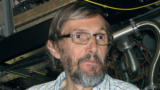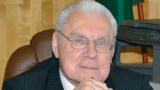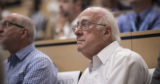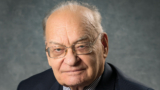
John Riley Holt 1918–2009

John Holt was an experimental physicist whose career started with small-scale bench-top experiments just after the discovery of nuclear fission and progressed to the large-scale experiments of today.

Holt came to Liverpool University's physics department in 1934 as a student aged 16; he graduated in 1938 and won the Oliver Lodge Prize for the best undergraduate student in his year. The department was propelled onto the world stage of physics with the arrival of James Chadwick in 1935, the year in which he won the Nobel Prize for his discovery of the neutron. Holt joined Chadwick as a graduate student and started work on studies of artificial radioactive isotopes. The studies changed direction abruptly at the beginning of the Second World War, when Otto Frisch and Rudolf Peierls surmised that a nuclear weapon could be created with a few kilograms of 235U – rather than the tons referred to in Albert Einstein's famous letter to President Roosevelt in 1939. To verify the Frisch–Peierls calculations the rudimentary information available had to be improved. Liverpool, with its newly built cyclotron, became the centre for the necessary measurements and Holt became Frisch's assistant. The culmination of this work was the proof of the feasibility of the production of a nuclear weapon, paving the way for the Manhattan Project.

Holt made several significant discoveries during his career. He was the first to discover that the angular distributions of particles emitted in deuteron-stripping reactions could be used to deduce the orbital angular momentum of the higher energy levels of the final-state nucleus. The agreement of these values with the predictions of the newly proposed shell model of the nucleus helped gain credence for the model. He also measured the helicity of the decay electrons and positrons from muon decay, firmly establishing the weak interaction as a vector and axial-vector interaction rather than as pseudoscalar-tensor, as thought at the time. Furthermore, his demonstration that the helicity of electrons from μ decay was opposite to that of positrons from μ+ decay proved the violation of charge-conjugation invariance in weak decays. These facts are now taken for granted in the Standard Model.

High precision became bywords for Holt's later experiments, such as πp scattering at the 156 inch synchrocyclotron in Liverpool and a series of studies of π0 and η photoproduction at the electron synchrotron NINA at the Daresbury Laboratory. In the NINA scrapbook, published to celebrate the synchrotron's 10th anniversary of the electron synchrotron, Sandy Donnachie wrote: "Holt's name has become synonymous with precision and accuracy". Holt had earlier been responsible for the design of the magnet system for NINA, which enabled the first direct extraction of a beam from such a machine.

Holt's final experiment was on deep-inelastic muon scattering in the European Muon Collaboration at CERN in the mid-1980s. His group developed a very large polarized target for experiments to study the spin of the proton in terms of the constituent quarks. The results obtained from these experiments showed that the proton's spin was not simply distributed among its quarks, overturning all of the preconceived ideas of the time. This led to an avalanche of theoretical papers and spawned a whole new series of experiments around the world.

Holt was elected to a Fellowship of the Royal Society in 1964. His deep understanding of the experimental method meant that his opinions were highly valued when important decisions were needed. He was keen to communicate his great enthusiasm for physics to people within and outside the academic world. He was kindly, unassuming and led by example, never seeking the limelight, preferring to work with colleagues young and old. In meetings he was a man of few words but every one counted. His main form of relaxation was gardening and he enjoyed collecting exotic shrubs and trees.

His wife Joan died in 2001 and he is survived by his sons David and Eric and grandsons Christopher and Timothy.

T Sloan, Lancaster University.


Daniel Morellet 1925–2009

Daniel Morellet nous a quittés le 4 mars dernier, dans sa quatre-vingt quatrième année. Il était entré en 1947 dans le Laboratoire du Professeur Louis Leprince-Ringuet à l'Ecole Polytechnique pour étudier les particules élémentaires. Les rayons cosmiques étaient alors l'unique source de particules de haute énergie et leurs propriétés devaient être observées avant que leur énergie ne soit dégradée par leur interaction avec les noyaux de l'atmosphère terrestre. Daniel Morellet fit partie du groupe qui utilisait des émulsions photographiques à la fois comme cible et comme détecteur et les exposait dans la stratosphère au moyen de ballons-sondes. Il était chargé de l'organisation du vol de ces ballons, ainsi que du développement, très délicat, des émulsions qui étaient ensuite observées au microscope pour détecter et mesurer les trajectoires des particules. Tout le groupe étudiait les mésons π, puis des mésons plus lourds – appelés 'étranges' à l'époque – et les hypérons après leur découverte.

Dès l'apparition des premiers accélérateurs, les émulsions comme les chambres de Wilson furent rapidement délaissées au profit de moyens de détection mieux adaptés et le laboratoire construisit des chambres à bulles pour ses premières expériences au PS du CERN. Daniel Morellet rejoignit alors le groupe des Chambres à Bulles à liquides lourds, dirigé par André Lagarrigue. Il étudia les problèmes de statistique liés aux mesures dans ces chambres et à la détermination des quantités physiques objet des expériences ; il s'attacha à définir les méthodes correctes et à les enseigner.

Quand, en 1964, André Lagarrigue fut nommé professeur à Orsay, Daniel Morellet le suivit avec la moitié du groupe et le seconda jusqu'à sa disparition. Il prit en charge l'installation au Laboratoire de l'Accélérateur Linéaire (LAL) puis la préparation des moyens d'analyse pour la grande chambre à bulles Gargamelle construite au CEA sous la direction d'André Lagarrigue. Il contribua à la grande et difficile aventure de l'étude des interactions des neutrinos qui déboucha sur la découverte des courants neutres, l'une des plus importantes découvertes de la physique des particules au siècle dernier.

Au décès d'André Lagarrigue, il devint responsable du groupe 'Chambre à Bulles' puis sous-directeur du LAL et accompagna la réorientation de ses physiciens vers des expériences d'électronique sur les machines du CERN et de DESY. Sa charge principale fut alors de faire fonctionner les services du laboratoire pour assurer un soutien technique et administratif aux expériences. Il encouragea en particulier le développement de l'informatique au laboratoire et l'utilisation de la conception assistée par ordinateur pour l'électronique. Il s'acquitta de cette tâche souvent difficile avec beaucoup de dévouement, trouvant un dérivatif dans les cours de physique atomique et nucléaire qu'il donnait à l'Ecole Supérieure d'Electricité et surtout dans la poursuite de ses travaux sur le développement des gerbes électromagnétiques qui ont permis d'améliorer la qualité de la mesure des électrons dans tous les types de détecteurs

Ceux qui l'ont connu garderont le souvenir de la qualité de son accueil, de son humour, de son ouverture d'esprit et de son tempérament toujours égal. Il était attentif à tous les problèmes, petits ou grands, qui apparaissaient dans le laboratoire et il fit en sorte que chacun, chercheur ou technicien, trouve la place qui lui convenait et les moyens dont il avait besoin. Il fit beaucoup, souvent dans l'ombre, pour la réussite des expériences.

Ses collègues et amis.