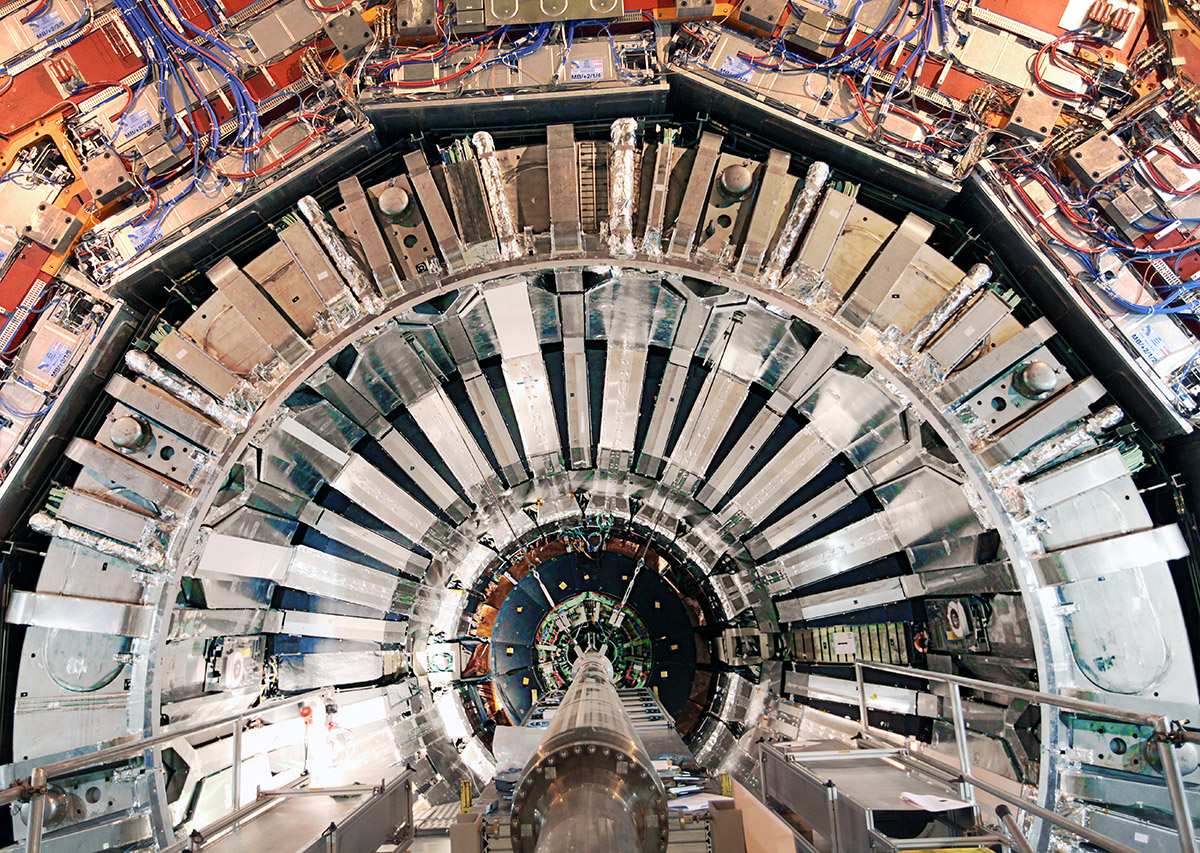
Historically at CERN the control of equipment not used directly for data acquisition has been called "slow control", presumably because of the much lower bandwidth required and response times measured in tens of milliseconds, if not tens of seconds. It has also often been a subject addressed as an afterthought. However, with the size of the experiments for the Large Hadron Collider (LHC), or even those currently operating with fixed targets, so much equipment has to be monitored and operated that running the experiments would be difficult, if not impossible, without an efficient slow-control system.
The difference between control in high-energy physics experiments (excluding data acquisition) and most industrial systems is now mainly one of size, and herein lies the benefit of not being required to push the technological frontiers too much. In many applications it has become possible to use commercial off-the-shelf (COTS) solutions, with the advantage that the physics community does not need to develop or maintain them (the latter is perhaps more important). However, nothing comes without a price, and in this case it is the need to follow industrial standards.
Control systems
For the controls of the LHC experiments, the Joint Controls Project (JCOP) was set up in 1998 as a collaboration between the four experiments (ATLAS, ALICE, CMS and LHCb) and CERN to provide common control solutions. In the early phases of the project it was decided to evaluate COTS solutions for their suitability for the LHC experiments. Programmable logic controllers (PLCs), which were already widely used in more standard industrial applications at CERN (such as cooling and ventilation, vacuum, etc), but less so for experiment controls, were investigated for suitability. Following an evaluation, it was felt that these could indeed be used in many areas within experiment controls where reliable process control was required, but where there was no need for latencies lower than a few tens of milliseconds, and no need for highly sophisticated software processing. PLCs are now used extensively, but still perhaps less than they could be.
A second area where industrial solutions looked promising was supervisory process control and hardware interfacing. A de facto industry standard called OPC (object linking and embedding [OLE] for process control) was emerging and promised to reduce substantially the number of interface protocols that a controls system needed to support. In the past, each different PLC type to be connected meant another proprietary protocol to support. However, with OPC, a single interfacing standard was defined by manufacturers of PLCs and other kinds of hardware equipment. Thus, each hardware supplier provides a software interface called an OPC server. Similarly, providers of supervisory control and data acquisition (SCADA) software provide the corresponding OPC client capability. After evaluation it was decided that OPC would be a good choice to standardize the interfacing of COTS equipment.
A third area where COTS solutions were felt to be worth investigating was supervision systems. This was a far more complex area that required a more detailed evaluation, one that lasted two years from the initial survey of the market until the completion of the hands-on evaluation of a shortlist of products. The experiments eventually concluded that SCADA technology could be suitable for their controls systems, provided the chosen product:
• allowed very large scalable control systems to be built with the order of several million data items;
• was sufficiently open to allow all internal SCADA data to be accessible from external applications;
• allowed an object-oriented development approach - because an experiment-control system has a large number of similar devices, it is essential to be able to develop a class definition for each type of device once, then instantiate it easily many times;
• supported distributed development - the control systems of the LHC experiments would be developed in many distributed locations around the world;
• ran under both the Windows and Linux operating systems.
Although there were very many SCADA products on the market at that time (more than 100), only a small number were found to support all these requirements. PVSS (Prozeßvisualisierungs- und Steuerungssystem), from the Austrian company ETM, was one of these and was selected after a formal tender process in 1999 for use in the control systems of the four LHC experiments. Since then, members of the four experiment collaborations in approximately 100 institutes in 26 countries have started working with PVSS to build their part of the overall control systems for these experiments. In addition, during 2000, after a study of the use of SCADA systems at CERN, a recommendation was made by the CERN Controls Board to minimize the number of SCADA systems used and to standardize on PVSS for all new CERN projects requiring SCADA functionality.
To enable efficient use of PVSS for these projects, the existing contract with ETM was extended to cover essentially all projects at CERN. As a result, PVSS has been used for many other systems at CERN, including several fixed-target experiments (COMPASS, NA60 and HARP), the gas and magnet control systems for the LHC experiments, the LHC cryogenics and vacuum-control systems, and the supervision of several safety systems for the LHC machine and experiments.
PVSS Users' Group
Because PVSS offers extensive functionality, its correct use needs experience and therefore a support service is provided to help users get started. The service, housed in the Controls Group of the Information Technology (IT) Department, also provides expert advice and technical support for more advanced users. Furthermore, a framework layer specific to high-energy physics has been developed to deal with common physics hardware components and to provide additional specific functionality.
The IT Controls Group has also maintained good contacts with users of PVSS outside CERN, and after discussions it became clear that having a forum in which to exchange ideas, solutions and experience on the use of PVSS would be potentially beneficial. Thus, in collaboration with ETM, it was decided to form a PVSS Users' Group. The first meeting of this group took place at CERN on 5-6 April 2005.
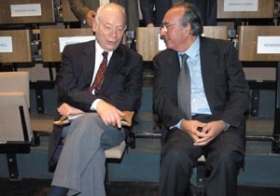
Nearly 150 participants attended the meeting, from a wide range of different application domains including high-energy physics, radio astronomy, air-traffic control, traffic monitoring, gas production and distribution, water distribution and purification, maritime navigation systems and many others. Approximately three-quarters of the participants were from outside of CERN and the majority of these from industry. The meeting programme included 14 interesting and diverse presentations on experience in the use of PVSS and special developments done with it, and there was a presentation on the foreseen future evolution of PVSS from ETM's point of view. Three lively discussion sessions were held, on "Design Aspects in Sophisticated PVSS Applications", "How to Develop Successfully Company Standards with PVSS" and "User Evolution Wishes for PVSS". The participants were also given the opportunity to visit the ATLAS cavern and the CMS installation hall, allowing them to see for themselves the size and complexity of the experiments that PVSS will be used to control.
The meeting concluded with a discussion on the future role of the Users' Group, and the outcome was that it would indeed be beneficial. It was decided that it should allow users of PVSS to meet and establish contacts for future collaborations, and provide a forum to:
• discuss each others' experiences, problems and solutions;
• discuss missing functionality and enhancements to the product;
• discuss and prioritize requests to ETM;
• discuss topics of relevance to the PVSS users' community, such as control-system security, emerging standards and the development of new technologies;
• allow ETM to communicate its development strategy for PVSS.
The consensus was that the meeting had been an excellent forum for users to meet and exchange ideas, and it brought together an interesting mix of people from research and industry. Although the industrial approach was sometimes quite different from that of the research domains, there were many similarities in the type of problems encountered and the solutions chosen. The seeds of new collaborations were sown at the meeting and it will be interesting to watch these develop in the weeks and months to come.
• For a conference report on the first PVSS Users Meeting at CERN see www.cerncourier.com/articles/cnl.