UNESCO meeting takes place at CERN

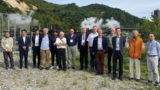
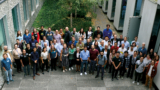
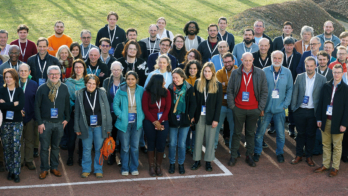
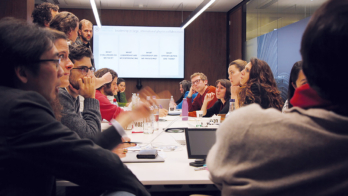
CERN director for technology transfer and scientific computing, Hans Hoffmann, chaired a meeting at CERN in April to discuss the development of an electronic regional research and education infrastructure aimed at re-integrating the countries of south-east Europe into the broader European infrastructure. Bringing together UNESCO regional representatives and representatives of the Max Planck Society, it follows UNESCO's March 2001 conference of experts on the reconstruction of scientific co-operation in south-east Europe, which was held in Venice.

The conference aimed to re-establish scientific links not only between the countries of south-east Europe, but also between them and the rest of Europe. It identified several courses of action to take, the first of which was a round table of science ministers hosted by UNESCO last October in Paris. CERN was chosen to host the second follow-up meeting because of its long-standing experience in computing and networking infrastructure, and in collaboration at a distance.

Riordan wins AIP communication award

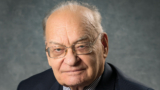
The American Institute of Physics has awarded its 2002 Andrew Gemant Award for communicating physics to Michael Riordan of Stanford University and the University of California, Santa Cruz.

Riordan, who has been CERN Courier's long-standing correspondent for the Stanford Linear Accelerator Center (SLAC), is the author of several books including The Hunting of the Quark, which draws on his experience as a graduate student on SLAC's landmark deep-inelastic scattering experiments of the 1960s and 1970s, and the award-winning Crystal Fire. He wrote this book, which traces the history of transistors, with Lillian Hoddeson.

The award is named after Andrew Gemant, a physicist who wrote six books, 16 volumes of short stories and 280 scientific papers. It has been awarded annually since 1987, and previous winners include Stephen Hawking, Steven Weinberg and Freeman Dyson.

"It's a great honour to be included in the company of these scientists, who have excelled in communicating physics and the role it plays in the wider web of human culture," said Riordan.

Future accelerator physicists hold symposium at CERN

A group of 42 students, postdocs and scientists from a German graduate college on the physics and technology of accelerators recently held a 4 day symposium at CERN. The college brings together physicists and electrical engineers from different departments of the Darmstadt University of Technology (TUD), the universities of Mainz and Frankfurt and the GSI laboratory. Supported by the Deutsche Forschungsgemeinschaft, it is built around the superconducting linear electron accelerator S-DALINAC at TUD, the electron microtron MAMI at Mainz, the various injector experiments at Frankfurt and the numerous heavy-ion developments at GSI. The college's experimental and theoretical work concentrates on improving existing electron and heavy-ion machines as well as the design and construction of future facilities.

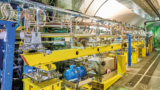
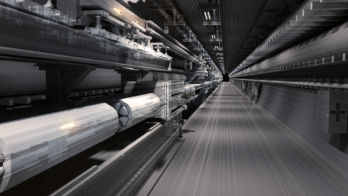
The symposium at CERN gave participants the opportunity to take a critical look at existing and future accelerators such as the laboratory's proton synchrotron complex and the compact linear collider study. Participants also investigated the sophisticated technology of detectors such as CMS and COMPASS. A highlight was a visit to CERN's facilities for the construction, assembly and testing of the superconducting magnets for the Large Hadron Collider.

Call for European research proposals

The Laboratori Nazionali di Legnaro (LNL) of Italy's Istituto Nazionale di Fisica Nucleare, have been recognized by the European Commission as a Major Research Infrastructure for the period 1 November 2000 - 31 October 2003. The contract offers European research groups performing experiments at LNL facilities the opportunity to be refunded for subsistence and travel.

Eligible research teams are groups from all European countries and the associated states. Calls for proposals are issued twice a year, with deadlines for submission usually falling in January and June. The next deadline is 7 June. Proposals will be evaluated on the basis of their scientific merit by user selection panels. For further information and application forms see www.lnl.infn.it/~lsf_secr or email lsf_secr@lnl.infn.it.

JINR committees see Russia in the spring

The JINR programme advisory committee for particle physics met in Dubna, Russia, in April. Along with delegates from the institute's committees for condensed matter and nuclear physics, delegates heard reports from the organization's scientific council and the committee of plenipotentiaries of JINR member state governments. The agenda included preparing the institute's scientific programme for the next 7 years and the prospect of developing a university-type educational process at JINR. The particle-physics programme advisory committee discussed the status of JINR activities in the ATLAS, CMS and ALICE experiments at CERN.

The XXX SLAC Summer Institute: Secrets of the B Meson will be held at Menlo Park, California, US, on 5-16 August. The Institute begins with 7 days of pedagogical lectures designed for beginning post-doctoral experimentalists and theorists and advancing graduate students. It concludes with a 3 day Topical Conference. Contact Maura Chatwell at ssi@slac.stanford.edu or see http://www-conf.slac.stanford.edu/ssi/ for more information.

Diffraction 2002, the second international conference of a series that began in Cetraro, Italy, will be held in Alushta, Crimea, on 31 August - 5 September. Organized by the Bogolyubov Institute for Theoretical Physics, the Ukrainian Academy of Sciences, the University of Calabria and the Joint Institute for Nuclear Research, the conference will be followed by the XXXII International Symposium on Multiparticle Dynamics. Details are available at http://www.gluk.org/hadrons/diff2002.

The XXXII International Symposium on Multiparticle Dynamics, organized by the Joint Institute for Nuclear Research, JINR, in Dubna and the Bogolyubov Institute for Theoretical Physics (BITP) in Kiev will be held in Alushta, Ukraine, on 7-13 September. The symposium covers the most important topics of multiparticle dynamics in the physics of elementary particles, heavy ions and astrophysics. Details are available at http://thsun1.jinr.ru/ismd2002/; email ismd2002@thsun1.jinr.ru.

The 9th Euro Summer School on Exotic Beams will be held in Les Houches, France, and at CERN on 12-20 September. The school is intended for PhD students and young postdocs starting to work in fields related to radioactive ion beams. The school begins with a number of lectures on general topics given at CERN, with the main lecture programme following at Les Houches. Programme and registration details are available at http://cern.ch/euroschool2002.

The 2002 DESY Theory Workshop in Hamburg, Germany, on 24-27 September will focus on quantum chromodynamics (QCD). Topics will include hard processes, lattice QCD, QCD at non-zero temperature and density, and QCD and the physics of flavour. Full details of the programme and registration arrangements are available from http://www.desy.de/desy-th/workshop2002.

The 8th Topical Seminar on Innovative Particle and Radiation Detectors will take place at the University of Siena, Italy, on 21-24 October. It will focus on advanced technologies for experiments in particle physics and astrophysics. Particular attention will be given to the application of such detectors in other fields such as medicine and biology, security control and environment monitoring. Attendance will be by invitation and will be limited to approximately 150. Those interested should write to the organizing committee indicating name, address, affiliation and, if applicable, the title of a contribution. The deadline for submitting a 1 page abstract is 15 September. Further information is available from kaos@bo.infn.it, arco.paganoni@cern.ch or pelfer@fi.infn.it; or contact Professor F-L Navarria, Dip. di Fisica, Viale C Berti-Pichat 6/2, I-40127 Bologna, Italy. Tel. +39 051 2095082; fax +39 051 2095296.

The XXI Texas Symposium on Relativistic Astrophysics will be held in Florence, Italy, on 9-13 December. The programme will cover recent developments in astrophysics and cosmology along with related topics in gravitation and elementary particle physics. Details are available at http://www.arcetri.astro.it/~texaflor/.