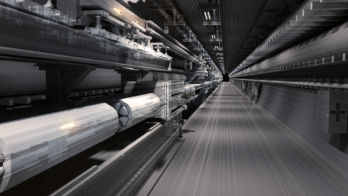
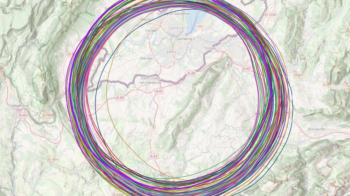
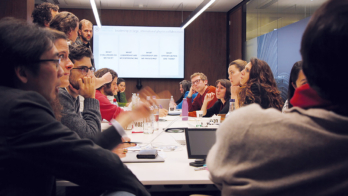
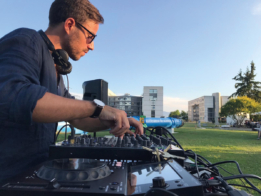
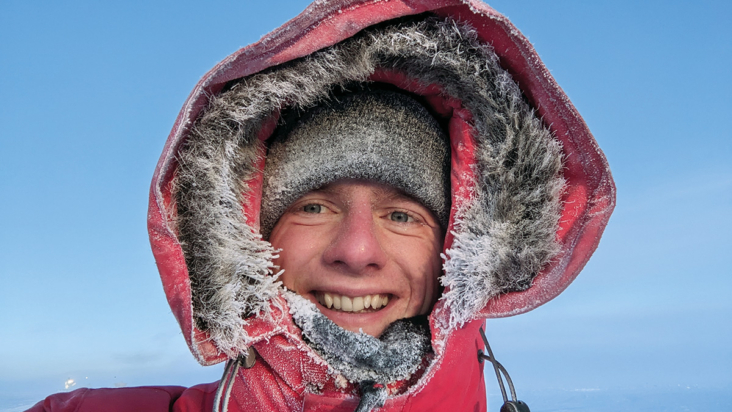
 Read article 'The coolest job in physics'
Read article 'The coolest job in physics'
Read article 'The coolest job in physics'

The papers assembled in this volume range in subject matter from dark-matter searches and gravitational waves to artistic and philosophical considerations.
A celebration of the opening of CERN Science Gateway, a new flagship centre for science education and outreach.
The directors of KEK, CERN, Fermilab and IHEP discussed a future global strategy at the 13th ICFA seminar.
 Read about 'Keep in touch: follow us on Twitter'
Follow @CERNCourier to keep up to date with the latest in high-energy physics
 Read article 'Tango for two: LHCb and theory'
The 13th Implications of LHCb measurements and future prospects workshop showcased mutual enthusiasm between the experimental and theoretical communities
 Read article 'Pushing accelerator frontiers in Bern'
The topical workshop “Gigahertz Rate and Rapid Muon Acceleration” showed how advanced accelerator concepts can jump-start dark-sector searches.
 Read article 'First TIPP in Africa a roaring success'
The 6th conference on Technology and Instrumentation in Particle Physics highlighted strong knowledge-transfer opportunities.
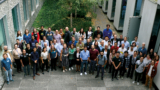 Read article 'A bright future for the Higgs sector'
Vector-boson scattering and the Higgs-boson self-coupling were among hot topics discussed at the 13th Higgs Hunting workshop.
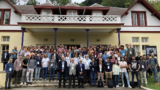 Read article 'Golden anniversaries in Spain'
Celebrating 50 years of the International Meeting on Fundamental Physics and the National Centre for Particle Physics, Astroparticles and Nuclear Physics.
 Read article 'Widening Balkan bridges in theory'
The Southeast European Network in Mathematical and Theoretical Physics looks back on 20 years of strengthening physics research in Balkan states.
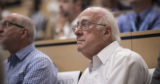 Read article 'Physics community pays tribute to Peter Higgs'
An iconic figure in modern science, Higgs in 1964 postulated the existence of the eponymous Higgs boson.
 Read article 'Science needs cooperation, not exclusion'
By accepting sanctions in science, writes Hannes Jung, we allow the dominance of politics over scientific cooperation.
 Read article 'A year of celebrations'
2024 CERN turns 70 and celebrates all year round with events commemorating CERN's different contributions to science and society.
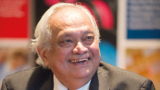 Read article 'Bikash Sinha 1945–2023'
Bikash Sinha nourished and led the Indian community to become a major pillar of ALICE.
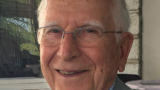 Read article 'Philippe Bernard 1935–2023'
Phillipe Bernard played a crucial role in the development of superconducting radio-frequency cavities.
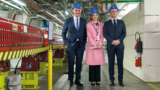 Read article 'CERN welcomes host-state presidents'
French and Swiss presidents Emmanuel Macron and Alain Berset visited CERN on 16 November.
 Read about 'In focus: US accelerator projects'
Evolution, ambition and international collaboration underpin US accelerator initiatives
Argonne National Laboratory
Brookhaven National Laboratory
Cornell University
EMFCSC
Enrico Fermi Centre
Fermi National Accelerator Laboratory
Forschungszentrum Jülich
GSI Darmstadt
IHEP, Serpukhov
INFN
Jefferson Laboratory
JINR Dubna
Lawrence Berkeley Laboratory
Los Alamos National Lab
NCSL
Nikhef
Novosibirsk Institute
Orsay Laboratory
PSI Laboratory
Saclay Laboratory
Science and Technology Facilities Council
SLAC National Accelerator Laboratory
SNOLAB
TRIUMF Laboratory