
A new class of baby radio galaxy has been discovered using very
long baseline interferometry. The sources, dubbed compact
symmetric objects, are the youngest radio galaxies ever observed
– a mere 1000 years old – and are expected to reveal clues to the
birth and evolution of these cosmic powerhouses.
Such
extreme sources could have links with gamma-ray bursts and
high-energy cosmic rays. Radio galaxies are a well known
phenomenon, characterized by enormous jets, up to millions of
light years across, shooting out charged particles at up to almost
the speed of light. Bright spots of emission are seen at the end of
the jets where the particles plough into the surrounding
intergalactic medium, depositing around 1044 erg/s
in energy.
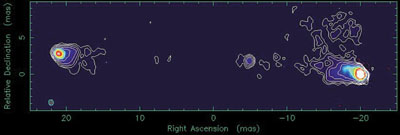
The new galaxies are almost identical but on a
smaller scale. Astronomers from the Onsala Space Observatory
in Sweden and the Max Planck Institute, Bonn, imaged them
with 17 different radio telescopes around the Earth
simultaneously. They calculate that the jets are expanding at
around a fifth of the speed of light and therefore are around a
1000 years old – babies on cosmic timescales.