Bob Wilson was a magician. Take, for example, his creation of Fermilab. This laboratory started as a proposal from the Lawrence Berkeley Laboratory for a 200 GeV accelerator to be built in seven years for $300 million. It was to be called the National Accelerator Laboratory. In due course the US Atomic Energy Commission (AEC) agreed to provide the funds but insisted that it should be built in Batavia, near Chicago. The Berkeley people refused, and the AEC turned to Wilson. He had already gone on record criticizing the Berkeley proposal as too conservative, too expensive and too long.
Wilson accepted the directorship and set out, more or less alone, to build the world's largest accelerator. So, with no staff, no laboratory and no buildings to work from, Wilson left for Batavia, a rural farm community in Illinois, to build the world's most sophisticated machine. Of course, he wasn't quite alone. Several people from Cornell and other accelerator laboratories joined, some permanent and some for a year or two. Accelerator builders were in short supply, and the existing laboratories worked hard to keep their people.
One of Wilson's first acts in his new task was to reset the goals: instead of 200 GeV, the design was for 400 GeV; instead of seven years, the construction time was shortened to six; and the price dropped to $250 million. In six years the machine was operating at 400 GeV and the cost was somewhat below the $250 million budgeted. How did he do it? That's the thing about magicians, you can't quite figure out how they do it.
Dreadful mistake
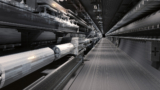
I don't mean to say it was all trouble free. Wilson and his group made one dreadful mistake. In his usual style, Wilson proceeded as fast as he could and found himself with a lot of magnets but no place to put them. He decided to store them in a part of the four-mile tunnel that had not yet been heated and was still pretty damp. The magnets stored there absorbed moisture through hairline cracks in the insulation, and, when the accelerator started operating, the magnets developed short-circuits. Wilson, a courageous magician, took a deep breath and, within about a year, during which time the accelerator was run as well as possible, slowly repaired the defective magnets as they failed. Boyce McDaniel, his longtime collaborator and successor as director of Cornell's Laboratory for Nuclear Studies, took a year's leave from Cornell to help to control the problem.
How important was it to reach 400 GeV? After all, 200 GeV was already about a factor of six greater than any other accelerator. In fact, this target was crucial. The two most important discoveries at Fermilab were the bottom and the top quarks - the two quarks making up the third and heaviest quark family. The bottom quark could not have been discovered at 200 GeV. I believe that Wilson could walk on water, but I don't believe that he foresaw this. I suspect it was pretty simple - 400 GeV was better than 200 GeV, and, in Wilson's judgement 400 GeV was possible with the allotted resources. Was it foolhardy? Was the risk too great? I don't think so. More could be learned from the more ambitious plan, so it was worth trying.
Superconducting magnets
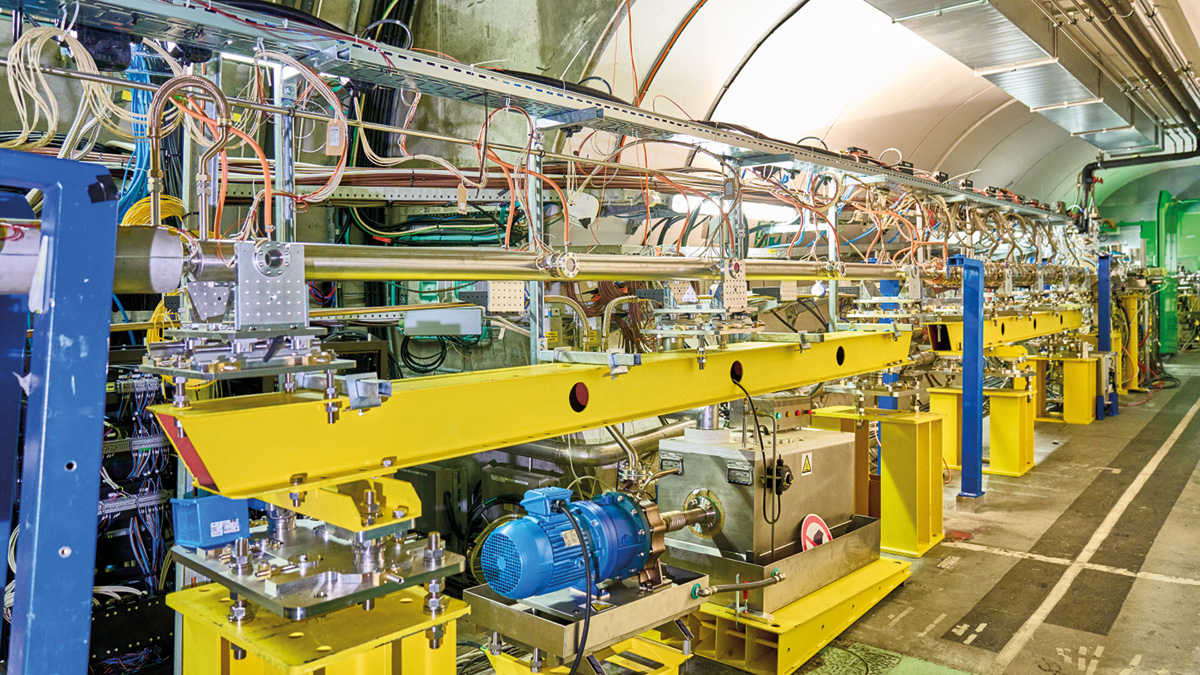
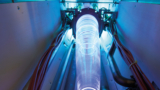
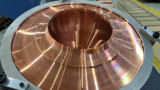
That wasn't the end of the magic. He soon started a project, the Tevatron, to raise the energy to 1000 GeV. He certainly had the idea of the energy increase from the beginning and had built the tunnel with this in mind, but the tunnel's radius was too small to use conventional iron magnets, which saturated at 500 GeV. Also, the power for 1000 GeV conventional magnets was prohibitive. The answer was superconducting magnets, the fields of which could be greatly increased and whose power requirements were reasonable.
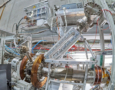
There was one small problem - no such magnet had ever been built. A few superconducting magnets had been used in experiments, but none reaching the stringent requirements of accelerator magnets. Also, one needed not a few but a thousand, very accurately made and highly reliable. Undeterred, he set to work building them. He set up an experimental facility at Fermilab, where he could build a magnet in a few weeks, test it, discover any problems and build an improved version, until he knew how to make them with sufficient accuracy and reliability. He did this himself, with his sleeves rolled up and his hands dirty. Of course, he had talented people working with him, particularly Alvin Tollestrup. It was a prodigious accomplishment and it was the new higher energy that made possible the discovery of the very heavy top quark. The third and heaviest family of quarks thus belongs to Fermilab and to Bob Wilson. The superconducting magnets also opened the door to a new accelerator era.
Art and science together
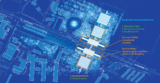
It wasn't only technically that Fermilab was beautiful; it was also beautiful to look at. Take, for example, the building now called Wilson Hall. Approaching Fermilab, you first see, about a mile away, an isolated tall building rising gracefully from the flat countryside. It looks more like a cathedral than a physics laboratory, and it's a surprising and exhilarating vision.
The aesthetics of Fermilab were important to Wilson. In an interview with Philip Hilts, published in the Washington Post of 20 February 1983, he spoke of these concerns. Among the features he mentioned were a 4 mile, 20 ft berm outlining the accelerator ring to mark the underground tunnel; a field planted with Illinois prairie grass, almost non-existent; and a herd of buffalo grazing inside the ring - a sight not seen in Illinois for 800 years. The grounds are dotted with sculptures, some by Wilson. Even the powerlines have a sculptural quality. These show the other side of Wilson - the artist who believed that science and art should blend to form a harmony that not only benefits scientific research and society but extends its culture.
This concern was eloquently expressed to Senator John Pastore on 17 April 1969 in testimony before the Joint Energy Committee of Congress:
Pastore: Is there anything connected with the hopes of this accelerator that in any way involves the security of this country?
Wilson: No sir, I don't believe so.
Pastore: Nothing at all?
Wilson: Nothing at all.
Pastore: It has no value in that respect?
Wilson: It has only to do with the respect with which we regard one another, the dignity of men, our love of culture. It has to do with whether we are good painters, good sculptors, great poets. I mean all the things we really venerate in our country and are patriotic about. It has nothing to do directly with defending the country except to make it worth defending.
In 1948, shortly before the first synchrotron was put into operation, in his yearly report to the Office of Naval Research, which funded the accelerator, Wilson described what he thought the research programme would be:
"The most important problems of nuclear physics, to our minds, are: what are the elementary particles of which nuclei are made, and what is the nature of the forces that hold these particles together? A more general but connected problem concerns the general expression of electrical laws at such high energies as will be produced by our synchrotron. Our experiments are planned to attack all three problems. Thus we hope to produce artificial mesons which are supposedly elementary particles, and to study their interactions with nuclei. Further, we shall explore the electrical interactions of high energy electrons with electrons and protons in search of evidence pointing to a correct theory of electricity at high energy."
Wilson's vision about future research was right on target. One would be hard put to improve on it today. It is the statement of a physicist with a very clear notion of why he was building the accelerator and where he was going. Wilson built accelerators because they were the best instruments for doing the physics that he wanted to do. No-one was more aware of the technical subtlety of these machines, no-one was more ingenious in practical design and no-one paid more attention to their aesthetic qualities, but it was the physics potential that came first. And the clear ideas that Wilson had about the that physics he hoped to do is amply demonstrated in the almost prophetic statement quoted above.
So, for some 20 years as director of the Laboratory of Nuclear Studies, Wilson remained deeply embedded in the physics programme, both as mentor and experimenter. He did important early experiments in pion photoproduction, which suggested to Bruekner the idea of nucleon excited states. He discovered the second nucleon excited state. He pioneered a class of experiments inside the synchrotron and with this technique did fundamental work on the structure of neutrons and protons, extending the pioneering work of Hofstadter at Stanford.
The following is a quotation from Wilson's 1953 report to the ONR describing the new project: "The Laboratory has indulged itself in some high adventure. A new synchrotron has been designed which is to give over a billion electron volts of energy. The design is highly controversial in that the new machine is exceedingly small and cheap for what it will do, hence there is considerable risk that it may not work at all. On the other hand, if we are successful, we shall have the largest electron accelerator in the world, and new areas of research will be opened to us. Our machine will cost us $200 000, while other machines giving much less energy have cost many millions of dollars."
This report tells us much about Wilson as an accelerator builder. Each new project was an adventure and an opportunity, and the more challenging the project, the more exuberantly it was embraced. It was pretty heady stuff, and we loved it and were inspired. The lab was a magical place. Despite Wilson's warning, the 1.2 GeV was a very successful machine. It not only did important physics, but its design paved the way to more compact, less expensive accelerators.
What is also revealing is the candour of Wilson's proposal to the ONR. There was no guarantee of success, only the guarantee of a scientifically exciting project worth the risk. It is a measure of the trust that the ONR had in Wilson that it unhesitatingly supported so modestly advertised a project.
The last machine Wilson built at Cornell was the 12 GeV synchrotron, at that time the world's highest-energy electron machine. This was the first accelerator to have the entire magnet (rather than just a vacuum chamber containing the beam) evacuated. This made it possible to reduce the vertical magnet aperture to 1 inch, simplifying the magnet construction and reducing the power demands. This idea was subsequently adopted for the Fermilab booster accelerator.
In the 1940s and 1950s, most of the accelerators were built at universities - perhaps 15 had frontline accelerators. The only one of which this is true today is Cornell. Cornell endured as an important centre of experimental high-energy research in this age of giant national and international laboratories, because it always had an accelerator with some unique physics capability built for a modest price. Wilson insisted on this during his tenure as director, and subsequent directors have continued in this "Cornell style".
It was this early interest in proton therapy that led Wilson first to provide a modest therapy facility at Fermilab, making use of the 200 MeV proton linac injector, and later to propose the use of the Harvard cyclotron for this purpose. Proton beams have now been used successfully for cancer therapy in a number of countries, usually as a secondary application on a machine designed for physics research. With the advent of Magnetic Resonance Imaging and Positron Emission Tomography, which can identify the positions of cancerous tumours with high precision, there has been an increased interest in the application of Wilson's ideas, and single-purpose hospital-based proton accelerators have been, and are being, built to extend this treatment. The first US single-purpose accelerator is at Loma Linda California Medical Center, having been built and tested at Fermilab.
The use of this technique is growing fast. New facilities are being built or planned in many places all over the world. The extent of this activity can be judged from the proceedings of the First International Symposium on Hadron Therapy at Como, Italy, in October 1993, to which more than 200 papers were contributed from Europe and the US. Wilson was honoured for his pioneering work in this area at an international conference at CERN in 1996.
There is much more to Wilson's career: his graduate work at Berkeley, where he did the first theoretical analysis explaining the stability of cyclotron orbits and tested his theory experimentally; his key role at Los Alamos as head of the Physics Research Division; his work for the civilian control of atomic energy, as chairman of the Federation of Atomic Scientists; his role in promoting international co-operation as one of the organizers of the International Committee on Future Accelerators (ICFA); and his very effective affirmative action programme at Fermilab, to choose a few examples.
Wilson's multifarious achievements did not go unrecognized. He was awarded honorary degrees from Notre Dame, Harvard, Bonn, and Wesleyan universities. He received the Elliot Cresson Medal from the Franklin Institute, the National Medal of Science, the Enrico Fermi award, the Wright prize, the del Regato Medal and the Gemant award, the last in recognition of his creative work in the arts and humanities. He was a member of the National Academy of Sciences, the American Academy of Arts and Sciences and the American Philosophical Society. In 1985 he was elected president of the American Physical Society.